
Daily Highlights: Hampshire Men v Essex, Rothesay County Championship
Watch highlights of each day of Hampshire Men's Rothesay County Championship match against Essex at Utilita Bowl


Quiz Question: Robin Smith needed 5 more runs at the end of the 2002 season to enter the top ten all-time Hampshire first-class run scorers. Who were the ten batsmen ahead of him in that list at the time?
See the bottom of the article for the answer
In February 2002, Eastleigh Borough Council’s planning committee granted planning permission for a £3m 20-acre golf-driving range and club house. In March, five million shares went on offer at £1 each with a minimum of £250 to each member and £2,000 to the public. There were then 4,839 members with the hope to raise £5m but the figure was £2.65m. The pavilion was now ready for the new season and Sport England awarded £150,000 for safety work on the ground. Plans were prepared for planning approval to construct two new stands with hospitality boxes.
The 2002 season was the first full year in which Hampshire County Cricket Club operated entirely from the Rose Bowl, marking the true beginning of a new era after the departure from Northlands Road in 2001. As such, the dominant theme of the season was adjustment—both to unfamiliar playing conditions and to the demands of a large, modern venue. In the First Division of the County Championship, Hampshire struggled to establish consistency, but there were some real highlights from individual players. John Crawley rewrote the record books on debut at Canterbury. His 272 included 36 boundaries; it was the fourth highest individual score in the club’s history at the time. When Hampshire declared on 671 for 8, it was a total just one short of the club’s highest ever team score in 1899 at Taunton. Nic Pothas, also on debut, made 48.
The match against Surrey at the Rose Bowl was a truly remarkable one for runs scored. Hampshire's second innings of score of 390 was their second highest-ever losing score in a match which saw 1577 runs. This figure was the second highest aggregate after Matthew Hayden’s Warwickshire game (235* & 119) in 1997 when 1,706 runs were scored at Northlands Road. Meanwhile Jimmy Adams and James Tomlinson also made their Championship debuts in 2002.
During the season, Robin Smith passed 25,000 first-class career runs. He was the only batter to make two Championship centuries. Robin finished the summer just 5 runs short of reaching the Hampshire top ten run scorers of all time. Will Kendall who wrote a really informative and entertaining diary of the 2002 season in the 2003 Hampshire Handbook carried his bat against Leicestershire at the Rose Bowl. It was the 26th occasion a Hampshire batter had carried his bat in a Championship game for the club.
For the bowlers, Chris Tremlett took his first five-wicket haul with 5-57 at Old Trafford against Lancashire. Alan Mullally returned the season’s best figures with 6-56 against Warwickshire at the Rose Bowl. In his Benefit Year, Shaun Udal again took more than 50 wickets. Overall, Hampshire finished 7th in the table and were relegated along with Somerset and Yorkshire. A significant number of matches ended in draws, reflecting both the character of the Rose Bowl pitches and a side still searching for balance. The surfaces in these early seasons were widely regarded as slow and unresponsive, offering limited assistance to bowlers and making it difficult to force victories.
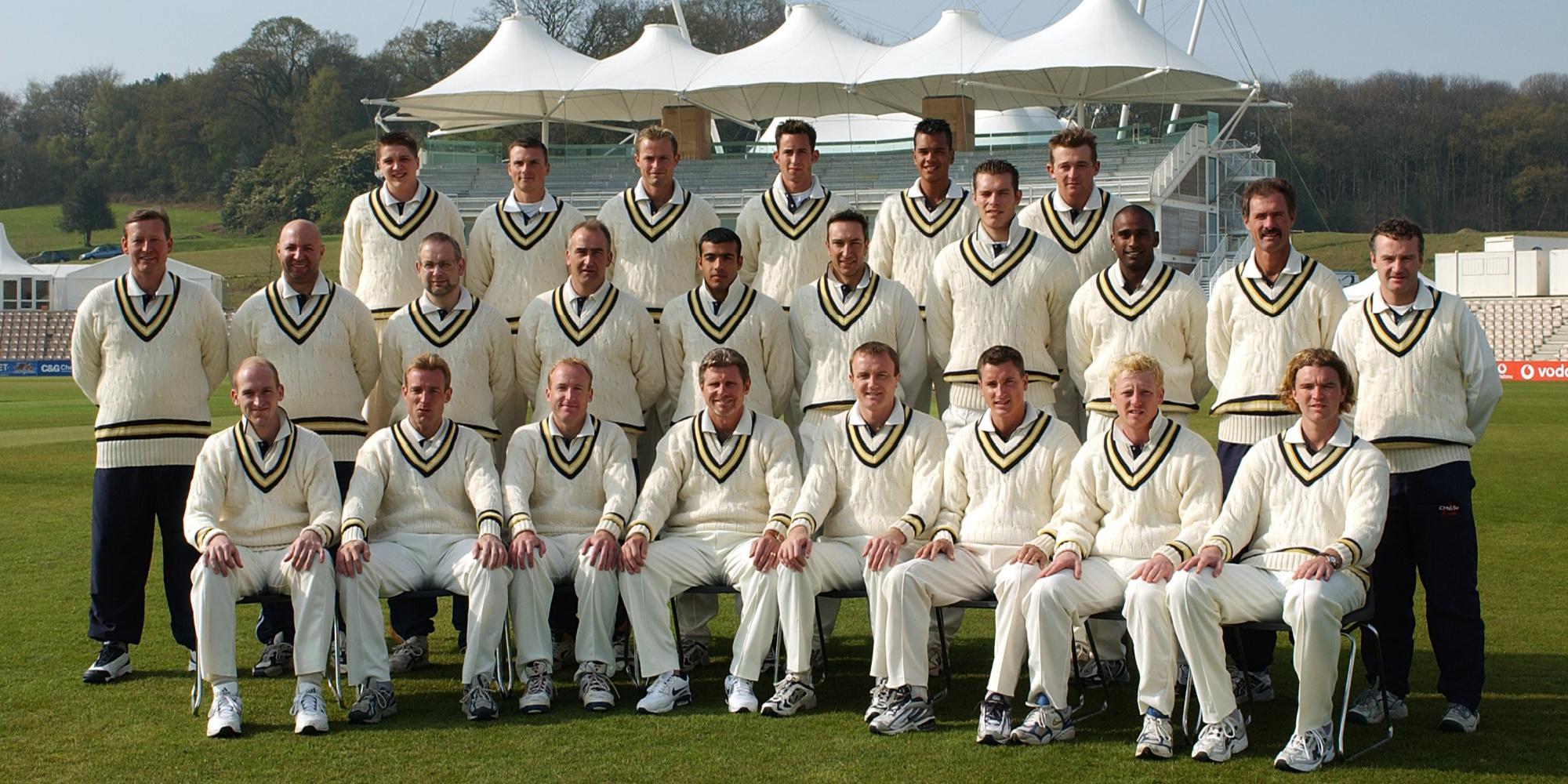
In one-day cricket, performances were similarly mixed. Hampshire competed respectably in the Norwich Union League Division Two but did not achieve promotion, while their cup campaigns did not produce a major run. However, there were signs of a developing one-day format identity that would soon become important. John Crawley made two limited overs centuries at the Rose Bowl: 113* against Somerset in the C&G Trophy and 103* against Middlesex in the B&H Cup. The other Rose Ball one-day game centuries were made by Will Kendall and John Francis. The only 5 wicket haul for Hampshire Hawks was Dimi Mascarenhas, when he took 5-27 at home against the Gloucestershire Gladiators. Jason Laney and Jimmy Adams both made double centuries for the 2nd XI. Adrian Aymes and Giles White retired at the end of the summer, while Robin Smith relinquished the captaincy.
Off the field, 2002 was arguably more significant. The Rose Bowl remained a work in progress, with infrastructure still being developed and refined. Permanent stands were gradually expanded, and spectator facilities improved as the club adapted to hosting larger crowds in a more modern setting. Crucially, the ground began establishing its reputation within English cricket. While still early in its life, it was increasingly seen as a future international venue, reflecting both its capacity and ambition. Overall, 2002 was a foundational season. Results were secondary to stabilisation, and by its end Hampshire had begun to adapt to their new home, even if success on the field remained limited.
Quiz Answer: Phil Mead, Roy Marshall, George Brown, Jimmy Gray, Johnny Arnold, Henry Horton, Gordon Greenidge, Peter Sainsbury, David Turner and Alec Bowell.
Robin eventually stands 9th in that list now with 18,984 first-class runs.
Throughout 2026, 25 Years of The Bowl will be marked through a series of celebrations reflecting the venue’s history, people and progress.
One of the headline moments of the anniversary year comes on Friday 29 May, as Hampshire Hawks v Surrey brings the Party Like It’s 2001 theme to life with a retro-themed Vitality Blast double header at Utilita Bowl.
Together, these moments will celebrate 25 years of The Bowl - past, present and future.
Watch highlights of each day of Hampshire Men's Rothesay County Championship match against Essex at Utilita Bowl
Read the match report & hear reaction from Hampshire Men's Rothesay County Championship match against Essex at Utilita Bowl
As we celebrate 25 Years of The Bowl, we uncover the stories behind the venue’s journey.